http://oneturkeyrun.blogspot.com/2016/12/aleppo-and-cambodia.html
I posted the above link on my Maine Writer Blog. It's titled "Aleppo and Cambodia".
Po Pot was a Cambodian who murdered his own people.
Assad is a Syrian who is destroying his own nation.
Both of them being the perpetrators of evil ambition.
Monday, December 19, 2016

Saturday, November 5, 2016
YouTube interview with Martha Gellhorne - reference Khmer Rouge
https://www.youtube.com/watch?v=qj9D3GIczW4
In this YouTube interview (link above) dated 1983, Gellhorn speaks candidly about her experience entering Dachau Concentration Camp, a chilling first person history.
Moreover, she described the "stupidity" (in her words) of the 1970s, political situation in Vietnam, whereby it became the Vietnamese, who defeated the US in their nation, that were then the liberators of the Cambodian people, who were suffering from the terrorism inflicted on them by the Khmer Rouge.
Martha Ellis Gellhorn was an American novelist, travel writer, and journalist, who is now considered one of the greatest war correspondents of the 20th century. She was one of writer Ernest Hemingway's wives.

Born: November 8, 1908, St. Louis, MO
Died: February 15, 1998, London, United Kingdom
Spouse: T.S. Mathews (m. 1954–1963), Ernest Hemingway (m. 1940–1945), Bertrand de Jouvenel (m. 1933)
Parents: Edna Gellhorn, George Gellhorn
Martha Gellhorn was a distinguished war correspondent who covered every war that occurred across the globe over a period extending nearly 60 years.
Born in 1908 in St. Louis, Missouri, Martha Gellhorn began her writing career as a crime writer in the late 1920s.
Her storied life as a war reporter began when she met Ernest Hemingway in late 1936, and she traveled with him to Madrid the following year to cover the Spanish Civil War. Gellhorn went on to cover every war that broke out during her lifetime, until the mid-1990s when her health began to give out. Stricken with cancer, she committed suicide in 1998.
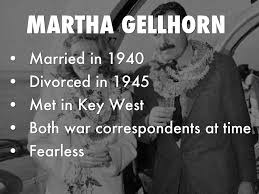
Martha Gellhorn was born in St. Louis, Missouri, on November 8, 1908. She attended Bryn Mawr College, in Philadelphia, but dropped out in 1927 to pursue journalism, writing early on for New Republic. She soon moved to Paris, working for various publications and joining the United Press Bureau, where she sought to become a foreign correspondent. While there, she aligned herself with the pacifist movement and wrote a book about her experiences in a novel, What Mad Pursuit (1934).
When Gellhorn returned to the United States, she was hired as an investigator for the Federal Emergency Relief Administration, who sent her around the country to document the impact of the Great Depression. Her reports caught the eye of Eleanor Roosevelt, and the two women became friends for life.
Gellhorn turned what she had witnessed into another work of fiction, The Trouble I've Seen (1936). The same year her book was published, she met Ernest Hemingway in a bar in Key West, Florida, and within months she was traveling with Hemingway to Spain to cover the rise of fascism and the Spanish Civil War for Collier’s Weekly. In 1940, Hemingway and Gellhorn were married, and he dedicated his Spanish Civil War novel, For Whom the Bells Toll (1940), to her.
Covering WWII and Vietnam
Gellhorn soon went to Western Europe to cover World War II, and in 1944 she allegedly stowed away on a hospital ship to report on the D-Day landings. The next year, she entered Dachau with American troops for the liberation of the infamous concentration camp (that same year, she and Hemingway split up), and her harrowing account was a landmark piece of journalism.
In 1966, she covered the war in Vietnam, which she found supremely disturbing and horrific, full of victims on both sides of the battles lines. In the 1980s she continued to travel extensively, writing about the wars in El Salvador and Nicaragua and the U.S. invasion of Panama, and in the mid-1990s she went to Brazil to write about street children there.
That would be her last significant article before her death, as, dying of cancer, she took her own life in 1998.
In this YouTube interview (link above) dated 1983, Gellhorn speaks candidly about her experience entering Dachau Concentration Camp, a chilling first person history.
Moreover, she described the "stupidity" (in her words) of the 1970s, political situation in Vietnam, whereby it became the Vietnamese, who defeated the US in their nation, that were then the liberators of the Cambodian people, who were suffering from the terrorism inflicted on them by the Khmer Rouge.
Martha Ellis Gellhorn was an American novelist, travel writer, and journalist, who is now considered one of the greatest war correspondents of the 20th century. She was one of writer Ernest Hemingway's wives.
Martha Gellhorn and Ernest Hemingway
WikipediaBorn: November 8, 1908, St. Louis, MO
Died: February 15, 1998, London, United Kingdom
Spouse: T.S. Mathews (m. 1954–1963), Ernest Hemingway (m. 1940–1945), Bertrand de Jouvenel (m. 1933)
Parents: Edna Gellhorn, George Gellhorn
Martha Gellhorn was a distinguished war correspondent who covered every war that occurred across the globe over a period extending nearly 60 years.
Born in 1908 in St. Louis, Missouri, Martha Gellhorn began her writing career as a crime writer in the late 1920s.
Her storied life as a war reporter began when she met Ernest Hemingway in late 1936, and she traveled with him to Madrid the following year to cover the Spanish Civil War. Gellhorn went on to cover every war that broke out during her lifetime, until the mid-1990s when her health began to give out. Stricken with cancer, she committed suicide in 1998.
Martha Gellhorn and Ernest Hemingway
Martha Gellhorn was born in St. Louis, Missouri, on November 8, 1908. She attended Bryn Mawr College, in Philadelphia, but dropped out in 1927 to pursue journalism, writing early on for New Republic. She soon moved to Paris, working for various publications and joining the United Press Bureau, where she sought to become a foreign correspondent. While there, she aligned herself with the pacifist movement and wrote a book about her experiences in a novel, What Mad Pursuit (1934).
When Gellhorn returned to the United States, she was hired as an investigator for the Federal Emergency Relief Administration, who sent her around the country to document the impact of the Great Depression. Her reports caught the eye of Eleanor Roosevelt, and the two women became friends for life.
Gellhorn turned what she had witnessed into another work of fiction, The Trouble I've Seen (1936). The same year her book was published, she met Ernest Hemingway in a bar in Key West, Florida, and within months she was traveling with Hemingway to Spain to cover the rise of fascism and the Spanish Civil War for Collier’s Weekly. In 1940, Hemingway and Gellhorn were married, and he dedicated his Spanish Civil War novel, For Whom the Bells Toll (1940), to her.
Covering WWII and Vietnam
Gellhorn soon went to Western Europe to cover World War II, and in 1944 she allegedly stowed away on a hospital ship to report on the D-Day landings. The next year, she entered Dachau with American troops for the liberation of the infamous concentration camp (that same year, she and Hemingway split up), and her harrowing account was a landmark piece of journalism.
In 1966, she covered the war in Vietnam, which she found supremely disturbing and horrific, full of victims on both sides of the battles lines. In the 1980s she continued to travel extensively, writing about the wars in El Salvador and Nicaragua and the U.S. invasion of Panama, and in the mid-1990s she went to Brazil to write about street children there.
That would be her last significant article before her death, as, dying of cancer, she took her own life in 1998.
Saturday, July 30, 2016
Sydney Schanberg obituary 1934-1016
Sadly, I'm just learning about the work of Sydney Schanberg through his obituary. I regret never having the opportunity to meet him, because I certainly would have appreciated a conversation about Cambodia.
As the evil dictator Pol Pot's Maoist guerrillas closed in on Phnom Penh in the spring of 1975, Sydney Schanberg's editors at The New York Times instructed him to leave the Cambodian capital. The veteran war journalist ignored the order and together with his Cambodian interpreter Dith Pran, he continued reporting.
Within days of the Pol Pot's Khmer Rouge seizing the capital city, Dith would be expelled to the contryside, along with millions of other educated and urban Cambodians- the start of Pol Pot's genocidal attempt to creat an agrarian utopia.
Schanberg won a Pulitzer for his reports on the Khmer Rouge and Dith's remarkable survival story, which inspired the 1984 film, "The Killing Fields". Dith's mission, "was to tell the world what suffering his people were going through," he wrote. "It became my mission too."
Killing Fields journalist Sydney Schanberg dies at 82- BBCNews
US journalist Sydney Schanberg, whose reporting inspired the Oscar-winning Hollywood film, The Killing Fields, died at the age of 82, the New York Times reports.
Schanberg worked for the Times and won a Pulitzer Prize for reporting the fall of Cambodia to the Khmer Rouge in 1975.
His colleague, Dith Pran, was unable to leave and his four-year ordeal inspired Schanberg's work.
Schanberg died in Poughkeepsie after a heart attack earlier in the week.
His death was confirmed by Charles Kaiser, a friend and former Times reporter, the paper said.
In 1980, Schanberg described his Cambodian colleague's ordeal of torture and starvation at the hands of the Khmer Rouge in a magazine article, and later a book called The Death and Life of Dith Pran.
The Khmer Rouge was the ruling party in Cambodia from 1975 to 1979, during which time, it was responsible for one of the worst mass killings of the 20th Century. The genocide claimed the lives of more than a million people - some estimates say up to 2.5 million.
Under the Maoist leader Pol Pot, the Khmer Rouge tried to take Cambodia back to the Middle Ages, forcing millions of people from the cities to work on communal farms in the countryside.
But the attempt at social engineering had a terrible cost, and whole families died from execution, starvation, disease and overwork.
As the evil dictator Pol Pot's Maoist guerrillas closed in on Phnom Penh in the spring of 1975, Sydney Schanberg's editors at The New York Times instructed him to leave the Cambodian capital. The veteran war journalist ignored the order and together with his Cambodian interpreter Dith Pran, he continued reporting.
Within days of the Pol Pot's Khmer Rouge seizing the capital city, Dith would be expelled to the contryside, along with millions of other educated and urban Cambodians- the start of Pol Pot's genocidal attempt to creat an agrarian utopia.
Schanberg won a Pulitzer for his reports on the Khmer Rouge and Dith's remarkable survival story, which inspired the 1984 film, "The Killing Fields". Dith's mission, "was to tell the world what suffering his people were going through," he wrote. "It became my mission too."
Killing Fields journalist Sydney Schanberg dies at 82- BBCNews
Schanberg worked for the Times and won a Pulitzer Prize for reporting the fall of Cambodia to the Khmer Rouge in 1975.
His colleague, Dith Pran, was unable to leave and his four-year ordeal inspired Schanberg's work.
 |
| Sydney Schanberg 1934-2916 died in Poughkeepsie NY |
His death was confirmed by Charles Kaiser, a friend and former Times reporter, the paper said.
In 1980, Schanberg described his Cambodian colleague's ordeal of torture and starvation at the hands of the Khmer Rouge in a magazine article, and later a book called The Death and Life of Dith Pran.
Oscar awards
In 1975, Schanberg and Dith Pran ignored directives from Times editors to evacuate and stayed in Cambodia as almost all Western diplomats and journalists fled.
 |
| Pictures of some of the victims of the Khmer Rouge reign of terror |
Born in Clinton, Massachusettes, Schanberg joined the Times as a copy boy in 1959, and "rose quickly through the organization," said The Daily Telegraph (U.K.) He reported on the civil war in East Pakistan, now Bangladesh, in 1971, and met Dith a year later while covering the US bombing of North Vietnamese sanctuaries inside Camobida. Four years after the Khmer Rouge took Phnom Penh, "there was no news of Dith," said The New York Times. Racked with guild, Schangergtook time off to write about his experiences and to help Dith's wife and children to settle in the US.
Then, in 1979, word arrived that Dith had escaped to a refugee camp in Thailand. He had endured unimaginable hardship, surviving beatings, back breaking labor, and a diet of insects, rodants and as litle as a tablespoon of rice a day.
Schanberg immediately flew to Thailand and arranged for his friend to move to the US. Dith died in 2008.
Under the Maoist leader Pol Pot, the Khmer Rouge tried to take Cambodia back to the Middle Ages, forcing millions of people from the cities to work on communal farms in the countryside.
But the attempt at social engineering had a terrible cost, and whole families died from execution, starvation, disease and overwork.
Schanberg began writing a column about New York City for the Times, in 1981, said The Washington Post. But, the "abrasive, headstrong manner" that had served him well overseas led to clashes with his bosses, and his column was canceled in 1985. Schanberg went on to write for other outlets and became a mentor to young journalists, but he never turly got over the horrors of Cambodia. "You tell yourself things in order to function, but you're going to break down," he said.
"Eventually, you need to find room where you can sit alone and cry."
Friday, February 19, 2016
Open Letter to Maine Governor Paul LePage
"Where the spirit of the Lord is, there is liberty.’” 2 Corinthians 3:17 (In other words: Second Corinthians)
Donald Trump made a Biblical fool of himself when he couldn't state "2 Corinthians" correctly. Worse than being unable to state scriptural text, was the inability to understand the meaning of the passage.
Unfortunately, America's right wing Republican party might be adept at reciting scriptural text and references, but they ignore the meaning of the words they often memorize. This is particularly true when faced with the immigration issue.
Recently, Maine's Governor Paul LePage made immigrants and asylum seekers the victims of his horrible racist rhetoric. There's absolutely no reason, whatsoever, for Governor LePage to stigmatize immigrants and asylum seekers. LePage stereotyped them with terrible lables, called them names and accused them, without cause, of carrying "germs" into Maine. What's worse, Governor LePage ignores the reality of his own family. In fact, he grew up in Lewiston, Maine, in a family directly related to French-Canadian immigrants! When Governor LePage ran for office, he was complimented for being a Franco-American. Now, unfortunately, he has become an embarrassment to his heritage.
Now, the Holocaust and Human Rights Center on the campus of the University of Maine Augusta (UMA), has published an open letter to challenge the unjust ethnic criticisms of Maine's immigrants and asylum seekers. Shame on Governor Paul LePage!
Here is the text of the HHRC letter:
In the wake of the world's response to the (terrorist) tragedies in Paris and turmoil in Beirut this week (recently) our (Maine Governor LePage) Governor has announced that he would oppose any efforts to bring Syrian refugees to Maine. While our history is crowded with efforts to limit groups of people from coming to the US, there is little question that immigration has been one of the most important factors in making the US a world power, and is, arguably, the key to Maine's success as a state.
U.S. law is very clear on immigration. The issue is under Federal control, based on article six of the US Constitution, and has been reviewed several times by the Supreme Court,most notably in Hines vs Davidowitz in 1941. (Under the preemption doctrine, enforcement of a state alien registration law was barred by the federal Alien Registration Act.)

Since the end of the Civil War, when Republican Governor Samuel Cony declared, "From the very foundation of our government, it has been our policy to invite the freest immigration from every portion of the earth," Maine has had a love/hate relationship with its immigrants. But, for Governor LePage to take an anti-immigrant stance seems somewhat disingenuous. The largest group for immigrants to Maine in the 19th century were the French Canadians, including the Governor's ancestors. At the time, there was also a good deal of rhetoric and discrimination against them. Most people know that the Ku Klux Klan movement in Maine in the 1920s, was mostly focused on the French-Catholic immigrants from Canada. Governor LePage has talked about the racism he felt growing up in "Little Canada", in Lewiston. He is, by all accounts, a self-made man, and a proud model of the success an immigrant can have in Maine, as are our Senator Susan Collins (Irish and English), former Senator Snowe (Greek), former Senator Mitchell (Lebanese) and many other prominent Mainers.
This fall, at the Holocaust and Human Rights Center of Maine, we have had a chalkboard in the lobby asking visitors, "What Country Are Your Ancestors From?" After two months, the board is filled with answers that reveal that Maine, like the rest of the country, is made up of people from all over the world. Of course, we'd expect to see Canada, France, Ireland, England, Sweden, Germany, Finland and mostly western European countries listed on the board. But, we might be surprised to see Guam, Jamaica, Belarus, Senegal, Lithuania, Cuba, Haiti, Somalia, Kenya, Ivory Coast, Russia, Poland, China, Humgary, Turkey, Brazil, Iceland, Australia, Rwanda, Lebanon and Sudan were listed; and, of course, a few people wrote that their ancestors are Native Americans.
It's interesting to note that our post Civil War interest in immigrants was fueled mostly by the fact that so many of our Maine boys got out, saw the possibilities in the rest of the country and decided not to come back home. That's what caused Governor Cony to make his bold statement that immigrants would be welcomed in Maine.
A few years later, Maine's Civil War hero Joshua Chamberlain was Governor. He encouraged Maine residents to think differently about the issue of the outward migration of our youth. "We have been too long content with the doubtful compliment that 'Maine is a good State to go from.' She must be made a good State to come to and to stay in." We've complained for about 150 years now about our young people leaving, perhaps it's time for us to revisit that argument as well. Maybe, we should try harder to welcome everyone who wants to come to Maine or stay in Maine. And yes, that includes immigrants and the children of immigrants.
Maine is a rich tapestry made up of individuals from around the world, and while we know that most immigrants and all refugees are vetted, we disagree with the concept that someone should be considered subversive or a danger to the American people simply because of their country of origin, religion, color of their skin, sexual orientation, or any other broad measure of a group of people. That's surely not an American or Maine measure of a person. As Dr. (Martin Luther) King suggested, many years ago, we should measure people by the content of their character. Maine's character is clearly composed of people from all over the world. Rather than opposing those who would seek refuge in a safe land and contribute to our society, we should embrace them and remember, in their quest for a new home, they're very much like our own ancestors.
Written by David Greenham, Program Director, Holocaust and Human Rights Center of Maine.
Obviously, Republicans have a big problem understanding the Scripture they claim to revere. 2 Corinthians. Sadly, they do not advocate for the intent of this Biblical passage. For selfish reasons, Republicans do not believe in providing liberty for those who are seeking the spirit of freedom.
Donald Trump made a Biblical fool of himself when he couldn't state "2 Corinthians" correctly. Worse than being unable to state scriptural text, was the inability to understand the meaning of the passage.
Unfortunately, America's right wing Republican party might be adept at reciting scriptural text and references, but they ignore the meaning of the words they often memorize. This is particularly true when faced with the immigration issue.
Recently, Maine's Governor Paul LePage made immigrants and asylum seekers the victims of his horrible racist rhetoric. There's absolutely no reason, whatsoever, for Governor LePage to stigmatize immigrants and asylum seekers. LePage stereotyped them with terrible lables, called them names and accused them, without cause, of carrying "germs" into Maine. What's worse, Governor LePage ignores the reality of his own family. In fact, he grew up in Lewiston, Maine, in a family directly related to French-Canadian immigrants! When Governor LePage ran for office, he was complimented for being a Franco-American. Now, unfortunately, he has become an embarrassment to his heritage.
Now, the Holocaust and Human Rights Center on the campus of the University of Maine Augusta (UMA), has published an open letter to challenge the unjust ethnic criticisms of Maine's immigrants and asylum seekers. Shame on Governor Paul LePage!
Here is the text of the HHRC letter:
In the wake of the world's response to the (terrorist) tragedies in Paris and turmoil in Beirut this week (recently) our (Maine Governor LePage) Governor has announced that he would oppose any efforts to bring Syrian refugees to Maine. While our history is crowded with efforts to limit groups of people from coming to the US, there is little question that immigration has been one of the most important factors in making the US a world power, and is, arguably, the key to Maine's success as a state.
U.S. law is very clear on immigration. The issue is under Federal control, based on article six of the US Constitution, and has been reviewed several times by the Supreme Court,most notably in Hines vs Davidowitz in 1941. (Under the preemption doctrine, enforcement of a state alien registration law was barred by the federal Alien Registration Act.)
Maine Governor Samuel Cony (Governor 1864-1867) b. 1811 d. 1870 in Augusta ME "...invite the freest immigration...."
This fall, at the Holocaust and Human Rights Center of Maine, we have had a chalkboard in the lobby asking visitors, "What Country Are Your Ancestors From?" After two months, the board is filled with answers that reveal that Maine, like the rest of the country, is made up of people from all over the world. Of course, we'd expect to see Canada, France, Ireland, England, Sweden, Germany, Finland and mostly western European countries listed on the board. But, we might be surprised to see Guam, Jamaica, Belarus, Senegal, Lithuania, Cuba, Haiti, Somalia, Kenya, Ivory Coast, Russia, Poland, China, Humgary, Turkey, Brazil, Iceland, Australia, Rwanda, Lebanon and Sudan were listed; and, of course, a few people wrote that their ancestors are Native Americans.
It's interesting to note that our post Civil War interest in immigrants was fueled mostly by the fact that so many of our Maine boys got out, saw the possibilities in the rest of the country and decided not to come back home. That's what caused Governor Cony to make his bold statement that immigrants would be welcomed in Maine.
A few years later, Maine's Civil War hero Joshua Chamberlain was Governor. He encouraged Maine residents to think differently about the issue of the outward migration of our youth. "We have been too long content with the doubtful compliment that 'Maine is a good State to go from.' She must be made a good State to come to and to stay in." We've complained for about 150 years now about our young people leaving, perhaps it's time for us to revisit that argument as well. Maybe, we should try harder to welcome everyone who wants to come to Maine or stay in Maine. And yes, that includes immigrants and the children of immigrants.
Maine is a rich tapestry made up of individuals from around the world, and while we know that most immigrants and all refugees are vetted, we disagree with the concept that someone should be considered subversive or a danger to the American people simply because of their country of origin, religion, color of their skin, sexual orientation, or any other broad measure of a group of people. That's surely not an American or Maine measure of a person. As Dr. (Martin Luther) King suggested, many years ago, we should measure people by the content of their character. Maine's character is clearly composed of people from all over the world. Rather than opposing those who would seek refuge in a safe land and contribute to our society, we should embrace them and remember, in their quest for a new home, they're very much like our own ancestors.
Written by David Greenham, Program Director, Holocaust and Human Rights Center of Maine.
Obviously, Republicans have a big problem understanding the Scripture they claim to revere. 2 Corinthians. Sadly, they do not advocate for the intent of this Biblical passage. For selfish reasons, Republicans do not believe in providing liberty for those who are seeking the spirit of freedom.
Saturday, January 23, 2016
Comparing the Khmer Rouge with the ethnic cleansing of Yazidis
An article by journalist Rose George describes how one humanitarian woman compared the carnage perpetrated by the Khmer Rouge in Cambodia (The Killing Fields), with the ongoing and systematic ethnic cleansing of the Yazidis population, in Syria.
In the article titled, "All I can do is tell their stories," she reports:
"Evin traveled to Cambodia, where, having read about the Khmer Rouge, she met people who had suffeed under the regime. "I learned so much," she says, and she shared her own knowledge with others...."
The Yazidi are a Kurdish people who follow an old religion related to Zoroastrianism, but which has remnants of Hinduism, Judaism, Christianity and Islam. They are located primarily in the Nineveh province of northern Iraq. The sacred valley of Lalish is the center point of their culture. (Zoroastrianism is one of the world's oldest monotheistic religions. It was founded by the Prophet Zoroaster in ancient Iran, approximately 3500 years ago.)

 |
| Rose George writes "All I can do is tell their stories" in the February 2016 "The Rotarian" magazine. |
"Evin traveled to Cambodia, where, having read about the Khmer Rouge, she met people who had suffeed under the regime. "I learned so much," she says, and she shared her own knowledge with others...."
The Yazidi are a Kurdish people who follow an old religion related to Zoroastrianism, but which has remnants of Hinduism, Judaism, Christianity and Islam. They are located primarily in the Nineveh province of northern Iraq. The sacred valley of Lalish is the center point of their culture. (Zoroastrianism is one of the world's oldest monotheistic religions. It was founded by the Prophet Zoroaster in ancient Iran, approximately 3500 years ago.)
An icon representing Zoroastrianism
Link to the Rose George article and blog are here:
http://oneturkeyrun.blogspot.com/2016/01/syrian-refugees-tragically-brave.html
Friday, October 30, 2015
Budapest The Great Synagogue October 2015 Dohány Street Synagogue
I'm posting the blog about our October 2015 visit to The Great Synagogue in Budapest, Hungary. It's the largest synagogue in Europe. During World War II, it was also the site of a mass murder of Hungarian Jews. Many of the victims are buried in the Holocaust Memorial adjacent to the synagogue.


The Jewish Museum was constructed on the plot where Theodor Herzl's two-story Classicist style house used to stand, adjoining the Dohány synagogue.[12] The Jewish Museum was built in 1930 in accordance with the synagogue's architectural style and attached in 1931 to the main building. It holds the Jewish Religious and Historical Collection, a collection of religious relics of the Pest Hevrah Kaddishah (Jewish Burial Society), ritual objects of Shabbat and the High Holidays and a Holocaust room.
Heroes' Temple
The arcade and the Heroes' Temple, which seats 250 people and is used for religious services on weekdays and during the winter time, was added the Dohány Street Synagogue complex in 1931.

Built in a residential area between 1854-1859 by the Jewish community of Pest according to the plans of Ludwig Förster, the monumental synagogue has a capacity of 2,964 seats (1,492 for men and 1,472 in the women's galleries) making it the largest in Europe and one of the largest working synagogues in the world (after the Beit Midrash of Ger in Jerusalem, the Belz Great Synagogueand Temple Emanu-el in New York City). The consecration of the synagogue took place on 6 September 1859.
The synagogue was bombed by the Hungarian pro-Nazi Arrow Cross Party on 3 February 1939. It was used as a base for German Radio and also as a stable during World War II, the building suffered some severe damage from aerial raids during the Nazi Occupation but especially during the Siege of Budapest.

During the Communist era the damaged structure became again a prayer house for the much-diminished Jewish community. Its restoration started in 1991 and ended in 1998. The restoration was financed by the state and by private donations.


In 1944, the Dohány Street Synagogue was part of the Jewish Ghetto for the Budapest Jews and served as shelter for a lot of people. Over two thousand of those who died in the ghetto from hunger and cold during the winter 1944-1945 are buried in the courtyard of the synagogue.
It's not customary to have a cemetery next to a synagogue, but the establishment of the 3000 m2 cemetery was the result of historical circumstances. In 1944, as a part of the Eichmann-plan, 70.000 Jews were relocated to the Ghetto of Pest. Until January 18, 1945, when the Russians liberated the ghetto, around 8-10.000 people had died, although, one part of the deceased were transferred to the Kozma Street Cemetery, but 2.000 people were buried in the makeshift cemetery. In memory of those who had died, there is a memorial by the sculptor, Imre Varga, depicting a weeping willow with the names and tattoo numbers of the dead and disappeared just behind the Synagogue, in the Raoul Wallenberg Holocaust Memorial Park.


The Great Synagogue in Budapest Hungary where we visited in October 2015
Name is also Dohány Street Synagogue
Internet picture Dohány Street Synagogue
Jewish Museum
The Jewish Museum was constructed on the plot where Theodor Herzl's two-story Classicist style house used to stand, adjoining the Dohány synagogue.[12] The Jewish Museum was built in 1930 in accordance with the synagogue's architectural style and attached in 1931 to the main building. It holds the Jewish Religious and Historical Collection, a collection of religious relics of the Pest Hevrah Kaddishah (Jewish Burial Society), ritual objects of Shabbat and the High Holidays and a Holocaust room.
The arcade and the Heroes' Temple, which seats 250 people and is used for religious services on weekdays and during the winter time, was added the Dohány Street Synagogue complex in 1931.
The Heroes' Temple was designed by Lázlo Vágó and Ferenc Faragó and serves as a memorial to Hungarian Jews who gave their lives during World War I.
This particular post is published to the same blog where I described our sobering visit to The Killing Fields, in Phnom Penh, Cambodia where we visited several years ago. Both visits were sobering for providing evidence about man's senseless cruelty to man.
Po Pot led the evil Khmer Rouge to murder Cambodians, a genocide without cause. He presided over a totalitarian dictatorship, in which his government made urban dwellers move to the countryside to work in collective farms and on forced labour projects. The combined effects of executions, strenuous working conditions, malnutrition and poor medical care caused the deaths of approximately 25 percent of the Cambodian population


The Dohány Street Synagogue (Hungarian: Dohány utcai zsinagóga/nagy zsinagóga, Hebrew: בית הכנסת הגדול של בודפשט bet hakneset hagadol šel budapešt), also known as The Great Synagogue or Tabakgasse Synagogue, is a historical building in Erzsébetváros, the 7th district of Budapest, Hungary. It is the largest synagogue in Europe and one of the largest in the world. It seats 3,000 people and is a centre of Neolog Judaism.
The synagogue was built between 1854 and 1859 in the Moorish Revival style, with the decoration based chiefly on Islamic models fromNorth Africa and medieval Spain (the Alhambra). The synagogue's Viennese architect, Ludwig Förster, believed that no distinctively Jewish architecture could be identified, and thus chose "architectural forms that have been used by oriental ethnic groups that are related to the Israelite people, and in particular the Arabs".The interior design is partly by Frigyes Feszl.
The Dohány Street Synagogue complex consists of the Great Synagogue, the Heroes' Temple, the graveyard, the Memorial and the Jewish Museum, which was built on the site on which Theodore Herzl's house of birth stood. Dohány Street itself, a leafy street in the city center, carries strong Holocaust connotations as it constituted the border of the Budapest Ghett
This particular post is published to the same blog where I described our sobering visit to The Killing Fields, in Phnom Penh, Cambodia where we visited several years ago. Both visits were sobering for providing evidence about man's senseless cruelty to man.
Po Pot led the evil Khmer Rouge to murder Cambodians, a genocide without cause. He presided over a totalitarian dictatorship, in which his government made urban dwellers move to the countryside to work in collective farms and on forced labour projects. The combined effects of executions, strenuous working conditions, malnutrition and poor medical care caused the deaths of approximately 25 percent of the Cambodian population
Likewise, there was no reason for the Hungarians to participate in the 1944-45 genocide of the Budapest Jews.
In fact, our Hungarian guide in Budapest told us the Jews were persecuted with an unfathomable vengeance, so much so "even the Germans were amazed at their tactics".

Our Hungarian guide "Andre" said even the Germans were amazed by the persecution of the Jews by the "Hungarian Nazis" in Budapest. (Outside of The Great Synagogue)

Holocaust Memorial at The Great Synagogue in Budapest
Our guide said, even though the Jewish tradition is not to bury their dead at the synagogue, the exception was to create a memorial with graves of the victims of the Budapest Holocaust victims. This memorial was funded by the American actor, Tony Curtis.
The Dohány Street Synagogue (Hungarian: Dohány utcai zsinagóga/nagy zsinagóga, Hebrew: בית הכנסת הגדול של בודפשט bet hakneset hagadol šel budapešt), also known as The Great Synagogue or Tabakgasse Synagogue, is a historical building in Erzsébetváros, the 7th district of Budapest, Hungary. It is the largest synagogue in Europe and one of the largest in the world. It seats 3,000 people and is a centre of Neolog Judaism.
The synagogue was built between 1854 and 1859 in the Moorish Revival style, with the decoration based chiefly on Islamic models fromNorth Africa and medieval Spain (the Alhambra). The synagogue's Viennese architect, Ludwig Förster, believed that no distinctively Jewish architecture could be identified, and thus chose "architectural forms that have been used by oriental ethnic groups that are related to the Israelite people, and in particular the Arabs".The interior design is partly by Frigyes Feszl.
The Dohány Street Synagogue complex consists of the Great Synagogue, the Heroes' Temple, the graveyard, the Memorial and the Jewish Museum, which was built on the site on which Theodore Herzl's house of birth stood. Dohány Street itself, a leafy street in the city center, carries strong Holocaust connotations as it constituted the border of the Budapest Ghett

Holocaust memorial stone in the Jewish museum in Budapest Hungary
Built in a residential area between 1854-1859 by the Jewish community of Pest according to the plans of Ludwig Förster, the monumental synagogue has a capacity of 2,964 seats (1,492 for men and 1,472 in the women's galleries) making it the largest in Europe and one of the largest working synagogues in the world (after the Beit Midrash of Ger in Jerusalem, the Belz Great Synagogueand Temple Emanu-el in New York City). The consecration of the synagogue took place on 6 September 1859.
The synagogue was bombed by the Hungarian pro-Nazi Arrow Cross Party on 3 February 1939. It was used as a base for German Radio and also as a stable during World War II, the building suffered some severe damage from aerial raids during the Nazi Occupation but especially during the Siege of Budapest.


Holocaust Memorial at The Great Synagogue

Budapest street flowering column at The Great Synagogue
It's not customary to have a cemetery next to a synagogue, but the establishment of the 3000 m2 cemetery was the result of historical circumstances. In 1944, as a part of the Eichmann-plan, 70.000 Jews were relocated to the Ghetto of Pest. Until January 18, 1945, when the Russians liberated the ghetto, around 8-10.000 people had died, although, one part of the deceased were transferred to the Kozma Street Cemetery, but 2.000 people were buried in the makeshift cemetery. In memory of those who had died, there is a memorial by the sculptor, Imre Varga, depicting a weeping willow with the names and tattoo numbers of the dead and disappeared just behind the Synagogue, in the Raoul Wallenberg Holocaust Memorial Park.


L'Heureux photographs
Raul Wallenberg Memorial Park is home to the Holocaust Memorial, located in the backyard of the Great Synagogue. the Holocaust Memorial is also known as the Emanuel Tree (by Imre Varga), is a weeping willow tree. Each leaf is a memoril for a person who was killed in the Hungarian Holocaust. The memorial was inspired by the American actor Tony Curtis, who founded the Emanual Foundation, in New York City.
Friday, April 17, 2015
Forty Years after the Khmer Rouge in Cambodia - world attention still a challenge
Does Khmer Rouge sound like a harbinger of evil ISIS?
By the time the tyrannical rule of Pol Pot - or Brother Number One - was toppled four years later, an estimated two million Cambodians had been killed by execution, starvation or overwork as the Khmer Rouge drove the country back to Year Zero, through an agrarian peasant revolution. - Al Jazeera
Although the evil Khmer Rouge were eventually defeated in Cambodia, their horrific atrocites, inflicted against their own people, still haunt the nation, because few were held responsible.

Events in Phnom Penh commemorate start of Communist rule which exterminated quarter of country's population.
Survivors 40 years to the day since the Khmer Rouge marched on Phnom Penh, ending a civil war but heralding an era that would kill a quarter of Cambodians and leave the capital a ghost town.
A few hundred people, including monks and elderly regime survivors, gathered early on Friday at Choeung Ek - the most notorious of the regime's Killing Fields - on the capital's outskirts, burning incense and chanting Buddhist prayers at a memorial stupa housing the skulls and bones of victims.
The event commemorated the April 17, 1975, triumph of the Khmer Rouge over the US-backed republican army of Lon Nol and, with it, the start of four years of a genocidal communist revolution.
Initially, the Khmer Rouge were given a cautious welcome by Phnom Penh's war-weary residents as they entered the city astride tanks, their distinctive red-chequered scarves fluttering behind them.
But soon enough cadres began to evacuate the city of two million people at gunpoint, in one of the largest forced migrations in recent history.
The sick, elderly and very young perished, their bodies littering the roadsides, as "bourgeois" city dwellers were marched into the countryside to scratch a living from the parched soil.
By the time the tyrannical rule of Pol Pot - or Brother Number One - was toppled four years later, an estimated two million Cambodians had been killed by execution, starvation or overwork as the Khmer Rouge drove the country back to Year Zero through an agrarian peasant revolution.
"Forty years ago Pol Pot turned Cambodia into a hell - a ghost land," Huot Huorn, 67, told AFP news agency with tears in her eyes after lighting incense for the 36 relatives she lost to the regime.
"I still hate that regime ... their sins are vivid in my eyes now. They starved us, jailed people with no food and water until they died ... I saw them smash children's heads against a tree trunk."
By the time the tyrannical rule of Pol Pot - or Brother Number One - was toppled four years later, an estimated two million Cambodians had been killed by execution, starvation or overwork as the Khmer Rouge drove the country back to Year Zero, through an agrarian peasant revolution. - Al Jazeera
Although the evil Khmer Rouge were eventually defeated in Cambodia, their horrific atrocites, inflicted against their own people, still haunt the nation, because few were held responsible.
Cambodians mark 40 years since Khmer Rouge takeover
Killing Fields Memorial in Phnom Penh
Survivors 40 years to the day since the Khmer Rouge marched on Phnom Penh, ending a civil war but heralding an era that would kill a quarter of Cambodians and leave the capital a ghost town.
A few hundred people, including monks and elderly regime survivors, gathered early on Friday at Choeung Ek - the most notorious of the regime's Killing Fields - on the capital's outskirts, burning incense and chanting Buddhist prayers at a memorial stupa housing the skulls and bones of victims.
The event commemorated the April 17, 1975, triumph of the Khmer Rouge over the US-backed republican army of Lon Nol and, with it, the start of four years of a genocidal communist revolution.
Initially, the Khmer Rouge were given a cautious welcome by Phnom Penh's war-weary residents as they entered the city astride tanks, their distinctive red-chequered scarves fluttering behind them.
But soon enough cadres began to evacuate the city of two million people at gunpoint, in one of the largest forced migrations in recent history.
The sick, elderly and very young perished, their bodies littering the roadsides, as "bourgeois" city dwellers were marched into the countryside to scratch a living from the parched soil.
By the time the tyrannical rule of Pol Pot - or Brother Number One - was toppled four years later, an estimated two million Cambodians had been killed by execution, starvation or overwork as the Khmer Rouge drove the country back to Year Zero through an agrarian peasant revolution.
"Forty years ago Pol Pot turned Cambodia into a hell - a ghost land," Huot Huorn, 67, told AFP news agency with tears in her eyes after lighting incense for the 36 relatives she lost to the regime.
"I still hate that regime ... their sins are vivid in my eyes now. They starved us, jailed people with no food and water until they died ... I saw them smash children's heads against a tree trunk."
(Although Cambodians can never forget the terror of the Khmer Rouge, the world, unfortunately, seems to have passed over this terrible era.)
Subscribe to:
Posts (Atom)